Georgia Banking 8-K Explained: Q3 Investor Deck Filed
Georgia Banking Company filed an 8-K on November 6 with a third-quarter investor presentation. Here is what the EDGAR filing says and how Item 7.01 works.
- Filer
- Georgia Banking Company, Inc.
- Form
- 8-K
- CIK
- 1070965
- On EDGAR
- 0001104659-26-123603
A Regulation FD 8-K is a short current report in which a public company puts the slides it plans to show investors on the public record at the same time. Georgia Banking Company, Inc. (GBC) filed one on November 6, 2026, and this EDGAR filing explained here walks through the document and the third-quarter figures in its investor presentation.
What happened
The 8-K reports under two items. Item 7.01 (Regulation FD Disclosure) says the company posted an investor presentation to its website on November 6 and that management intends to use it in meetings with investors and analysts beginning November 9. Item 2.02 (Results of Operations) incorporates the presentation’s financial information for the quarter ended September 30, 2026. The presentation is Exhibit 99.1, and the filing was signed by Chief Financial Officer Charles M. DeWitt III.
The deck’s own legal language is informative. It refers to the company’s registration statement on Form S-1 (File No. 333-299281) and a final prospectus filed on Form 424B4, and lists “the limited trading history of the Company’s common stock” among its risk factors. In other words, GBC is a recently listed company, and this is one of its early investor-facing earnings documents.
The third-quarter numbers
The presentation describes the quarter as the first full one of combined operations with Tandem Bancorp, Inc., whose merger closed on June 1, 2026. That affects comparisons with earlier periods.
| Measure | Q3 2026 |
|---|---|
| Net interest income | $31.4 million (up 8.0% from Q2) |
| Net interest margin | 4.17% (down 14 basis points from Q2) |
| Diluted EPS | $0.57 (operating EPS $0.74) |
| Return on tangible common equity | 9.70% (operating 12.41%) |
| Loans held for investment | $2.2 billion average (up 23.7% from Q3 2025); 6.2% growth quarter over quarter |
| CET1 capital ratio | 10.59% (10.29% in Q2) |
| Nonperforming assets | 0.70% of total assets |
The company attributes the lower margin to the higher cost of refinanced subordinated debt. Noninterest income was $2.8 million, down 13.8% from the second quarter on lower retail mortgage originations. Its operating efficiency ratio was 62.3%. Average deposits were $2.7 billion, up 27.7% from the third quarter of 2025.
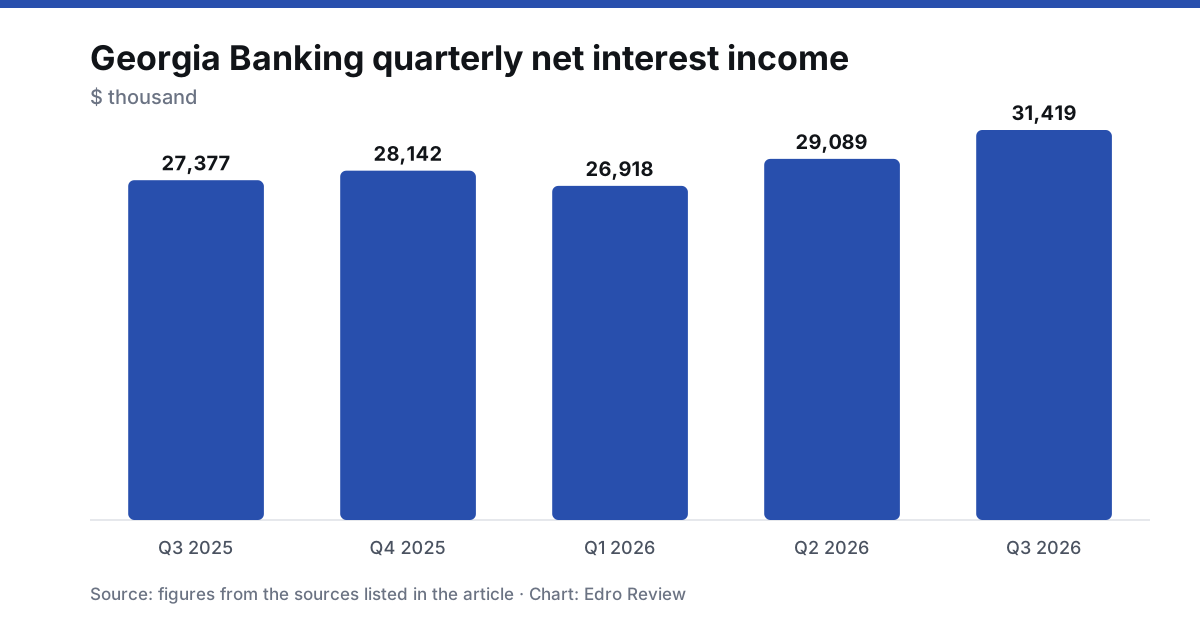
Net interest income by quarter, in thousands of dollars, from the deck: $27,377 (Q3 2025), $28,142, $26,918, $29,089 and $31,419 (Q3 2026).
How it works
Regulation FD, adopted by the SEC in 2000, bars public companies from sharing material nonpublic information with analysts and investors before it is available to everyone. Filing the slides on EDGAR under Item 7.01 is a common way to comply, since the presentation becomes public the moment the 8-K is accepted.
Information under Items 2.02 and 7.01 is “furnished,” not “filed.” GBC’s 8-K says so directly: it will not be deemed filed for Section 18 of the Exchange Act and is not incorporated into its Securities Act filings unless the company says so. The presentation also uses non-GAAP measures such as operating earnings and tangible book value per share, with reconciliations in its appendix.
Key terms
- Net interest margin: Interest earned on loans and securities minus interest paid on funding, as a share of earning assets.
- CET1: Common equity tier 1, the core regulatory capital ratio for banks.
- Operating efficiency ratio: Noninterest expense, adjusted for one-time items, divided by revenue. Lower is better.
- Core deposits: In GBC’s definition, deposits excluding time deposits over $250,000, national listing time deposits and brokered deposits.
FAQ
Is GBC listed on an exchange? Yes. The 8-K cover page lists GBC common stock on The Nasdaq Stock Market, and the deck’s reconciliations include $1.95 million of direct listing expenses in the third quarter, which indicates the shares were listed through a direct listing rather than a traditional IPO.
Where are the audited numbers? In the company’s periodic reports. The deck is an investor presentation, and its figures are unaudited.
Prepared with AI assistance from the documents listed in the margin and reviewed under our editorial policy. Not investment advice.